I recently spoke to a room full of dietitians about PMOS nutrition, and I wanted to bring that same information to you. (So here is a shortened version of my presentation)
If you have PCOS, you’ve probably already heard the name is changing. I want to walk you through why that happened, what’s actually different, and what the research says about nutrition for PMOS, because there’s a lot of fear-mongering out there around eliminating entire food groups based on very limited evidence, and I want you to have the right information instead.
PCOS vs. PMOS: At a Glance
| Old name | Polycystic Ovarian Syndrome (PCOS) |
| New name | Polyendocrine Metabolic Ovarian Syndrome (PMOS) |
| Why it changed | “Polycystic ovaries” implies actual cysts, which isn’t accurate. PMOS reflects what’s really happening: a metabolic and endocrine disorder |
| What changed | The name. That’s it. |
| What didn’t change | Diagnostic criteria stay exactly the same |
| What to call it now | Either PCOS or PMOS is correct during the 3-year transition |
| Who decided this | A global consensus of 56 clinical and patient organizations, built from over 14,000 survey responses |
Full YT Video
Table of contents
- PCOS vs. PMOS: At a Glance
- Full YT Video
- So, PCOS to PMOS. Why the Change?
- What’s Actually Changing (and What Isn’t)
- A Culinary Nutrition Approach to PMOS
- What the Research Actually Says About Diet for PMOS
- The Dietary Patterns With the Strongest Evidence
- Key Nutrients Worth Prioritizing
- Final Thoughts
- References
So, PCOS to PMOS. Why the Change?
The name went from Polycystic Ovarian Syndrome to Polyendocrine Metabolic Ovarian Syndrome. PCOS to PMOS.
This wasn’t one organization deciding to rebrand on its own. It was a global effort. 56 leading clinical and patient organizations came together, using over 14,000 survey responses from health professionals and patients, to build a global consensus.
Two things mattered most in that process. Patients wanted to make sure the name didn’t stigmatize them. Providers wanted to make sure it was actually accurate.
Here’s what “accurate” means in this case. “Polycystic ovaries” implies there are actual cysts on your ovaries. That’s not true when you have PCOS. You have polycystic-appearing ovaries, not actual cysts. Even the 2023 international guidelines said the name PCOS is misleading and is a barrier to care.
PMOS reflects what’s actually happening in the body. It’s a metabolic and endocrine disorder. It is not a fertility condition. It can have fertility or reproductive consequences, but that’s not the core of what it is.
We already knew that, but this rename is about making sure everyone else knows it too. PCOS is a lifelong metabolic and endocrine condition, and it deserves to be treated like other metabolic and endocrine disorders. FDA-approved medications, proper care, no shame.
One fun fact from the process: they also considered calling it EMOS, for Endocrine Metabolic Ovarian Syndrome. They ultimately didn’t, partly because of how closely it’s associated with the emo subculture, which I find pretty funny since I was a little bit of an emo kid back in high school myself.
What’s Actually Changing (and What Isn’t)
The diagnostic criteria, how you actually get diagnosed, has not changed.
What the name change does is push clinicians, researchers, and the people funding research to recognize that this condition touches your metabolic system, your reproductive system, your mental health, and your skin. Metabolic, reproductive, psychological, dermatological. All four.
On the mental health piece specifically, newer data shows just how prevalent eating disorders are in this population. We’re looking at a 53% increased risk of having an eating disorder overall. Bulimia nervosa carries a 34% increased risk. Binge eating disorder is roughly double the risk, and this holds regardless of your weight, which is exactly why eating disorder screening should be part of standard PMOS care.
As for the name itself, this is a three-year transition period, so saying PCOS or PMOS right now are both correct. It’s going to take time because electronic medical records need to update, medical coding needs to change, and World Health Organization alignment has to happen. The 2023 international guidelines for treatment and management are the current standard, and they’ll be updated again in 2028.
A Culinary Nutrition Approach to PMOS
The other half of what I covered was the research behind culinary medicine, and why it’s the approach I actually use with my clients.
Culinary nutrition is the integration of culinary arts and nutrition. It applies practical knowledge and skills to improve food and nutrition-related health. This is what I love about it: dietitians convert the science into actual food, and culinary medicine is what gives you the skills to make that happen.
One technical note: culinary medicine specifically is practitioner-led, meaning it has to be delivered by a healthcare provider.
Here’s why cooking skills and kitchen confidence matter so much. Nutrition changes are behavior changes, and behavior change is hard.
A scoping review looking at culinary medicine research pulled together 30 studies. In those studies, 81% showed improved dietary autonomy, self-efficacy, and confidence. Over 90% showed increased fruit, vegetable, and whole grain intake, along with less ultra-processed food. Fourteen studies tracked clinical markers, including lower A1c, lower inflammation, and improved cholesterol and triglycerides.
There’s also research on training medical personnel this way. One randomized controlled trial, a cooking curriculum for families focused on Mediterranean diet adherence and cost savings, found participants were nearly three times more likely to reach high-to-medium Mediterranean diet adherence by the end of the program. Fruit intake increased 4x, vegetable intake doubled, and whole grain intake went up 65%. It also saved families $21.70 a week by cooking more meals at home.
What the Research Actually Says About Diet for PMOS
I want to be really clear about this. There is no single best diet for PMOS. The evidence supports individualized, sustainable eating patterns over any restrictive protocol.
As a dietitian, that’s exactly what I don’t do: tell you “this is exactly what you should eat and there is no changing it.”
I look at your food preferences, your health goals, your cooking abilities, your access to food, whether you even like to cook. All of that shapes a strategy that’s actually going to work for you.
You also don’t have to follow one rigid approach to see results. Small changes make a real difference. As little as a 5% weight loss can show metabolic, reproductive, and psychological benefit. The research showed that culinary interventions don’t have to be extreme to move the needle on your symptoms and your health.
If there’s one dietary principle I want you to walk away with, it’s this: favor fiber over blanket carb restriction.
High-fiber, low-glycemic-index carbohydrates like whole grains, legumes, and fruit consistently outperform cutting carbs across the board. That’s true across all of the research I looked at.
And here’s the piece that doesn’t get talked about enough.
Education alone isn’t enough. Most people don’t need more information, they need to know how to actually implement it in real life. Hands-on, experiential cooking instruction drives adherence in a way that verbal or handout-based counseling simply doesn’t.
That’s the entire reason I started the PCOS Meal Prep Membership. It’s not about following one exact meal plan. It’s about getting together live on Zoom, cooking through recipes, asking questions, and prepping something for the week, so you can actually take what you’ve learned and put it into practice.
The Dietary Patterns With the Strongest Evidence
We know culinary medicine works for addressing the metabolic and endocrine issues tied to PMOS, specifically insulin resistance, cardiovascular disease risk, inflammation, and eating disorder risk.
Insulin resistance is the biggest one for me to drive home, for patients and providers both. It’s the central driver behind PMOS. It shows up in about 85% of individuals with PMOS overall, and still in about 75% of lean individuals.
This is critical to understand, because it’s what makes targeted nutrition interventions actually make sense. (I have a full video breaking down what insulin resistance is and what’s happening in the body, worth watching if you want to go deeper.)
On top of that, PMOS carries a significantly higher risk of cardiovascular disease, including heart attack and stroke. I don’t say that to scare you. I say it because understanding the real risks is part of why these nutrition and lifestyle changes matter so much.
When the evidence-based international guidelines did their own meta-analysis, they looked at 12 randomized controlled trials, the gold standard, covering about 500 participants total.
The dietary interventions studied included:
- DASH (3 studies)
- high-protein/low-carb (5 studies)
- high-fat/low-carb (3 studies)
- pulse-based low-glycemic-index diet (1 study)
Macronutrient composition varied a lot across all of them.
There’s also a broader systematic review of over 80 randomized controlled trials across diet, supplements, physical activity, and behavioral interventions for PMOS.
On the diet side specifically, the strongest evidence pointed to:
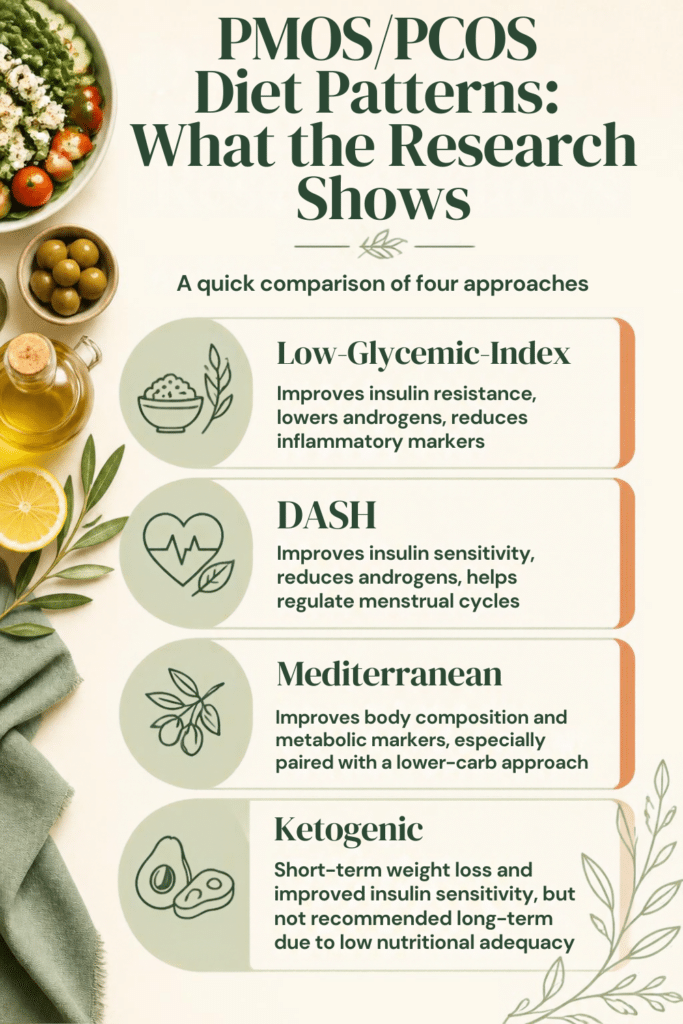
- The low-glycemic-index diet, which improved insulin resistance, lowered androgens, and reduced inflammatory markers.
- The DASH diet, which improved insulin sensitivity, reduced androgens, and helped regulate menstrual cycles.
- The Mediterranean diet, which improved body composition and metabolic markers, especially when paired with a somewhat lower-carbohydrate approach.
- And then there’s the ketogenic diet. As much as it pains me to say it, there is research behind it, so I have to present it fairly. It can produce meaningful short-term weight loss and improved insulin sensitivity. But the researchers themselves didn’t recommend it long-term, due to low nutritional adequacy from restricting whole food groups.
Key Nutrients Worth Prioritizing
A few things worth building your plate around.
- Anti-inflammatory foods like fruits, vegetables, whole grains, omega-3s help reduce inflammation directly
- Antioxidant-rich foods (think vitamin D, vitamin C, and polyphenols) have been shown to reduce oxidative stress markers tied to both insulin resistance and high androgens.
- Omega-3 fatty acids specifically improve insulin sensitivity, lower androgens, and carry mental health benefits on top of that.
- High fiber paired with adequate protein slows glucose digestion, so blood sugar rises more gradually instead of spiking.
- That matters because insulin spikes drive the estrogen/androgen production behind a lot of PMOS symptoms: irregular periods, acne, hair loss, hair growth, fatigue, all of it.
- Gut microbiome support, including probiotics, fermented foods, and prebiotic fiber, showing promise for both insulin resistance and lipid profiles.
Final Thoughts
As a person with PMOS and a dietitian specializing in the condition, I am very excited about the name change.
I truly think it will help the medical community and law makers (which is the most important thing for increased research funding) understand what PMOS is.
It deserves the attention and research dollars that other chronic medical conditions receive.
It’s my hope that this renaming leads to increased funding and an FDA approved medication for PMOS.
References
Used in my presentation and this blog post.
1. Teede HJ, et al. Polyendocrine metabolic ovarian syndrome, the new name for polycystic ovary syndrome: a multistep global consensus process. Lancet. 2026;407:2329-39. doi:10.1016/S0140-6736(26)00717-8 1b.
2. Teede HJ, Tay CT, Laven JJE, et al, and the International PCOS Network. International evidence-based guideline for the assessment and management of polycystic ovary syndrome 2023.
3.Gautam R, Maan P, Jyoti A, Kumar A, Malhotra N, Arora T. The Role of Lifestyle Interventions in PCOS Management: A Systematic Review. Nutrients. 2025;17(2):310.
4.Kazemi M, et al. Effects of dietary glycemic index and glycemic load on cardiometabolic and reproductive profiles in women with PCOS. Adv Nutr. 2021;12(1):161-178.
5.Cole EB, et al. Physician-Chef-Dietitian Partnerships for Evidence-Based Dietary Approaches: The Case for Culinary Medicine in Teaching Kitchens. J Healthy Longev. 2023. PMC10378677.
6.[Virtual plant-based culinary medicine RCT — diet quality, skin carotenoid status]. PMC11990422. (Confirm full citation on PubMed before submission.)
7.Nutrition from the kitchen: culinary medicine impacts students’ counseling confidence. BMC Med Educ. 2021. doi:10.1186/s12909-021-02512-2.
8.Donovan K, et al. Eat to Treat: The Methods and Assessments of a Culinary Medicine Seminar for Future Physicians and Practicing Clinicians. Nutrients. 2023;15(22):4819.
9.Croxford S, Stirling E, MacLaren J, McWhorter JW, Frederick L, Thomas OW. Culinary Medicine or Culinary Nutrition? Defining Terms for Use in Education and Practice. Nutrients. 2024;16(5):603.
10. Mozaffarian D, Blanck HM, Garfield KM, Wassung A, Petersen R. A Food is Medicine Approach to Achieve Nutrition Security and Improve Health. Nat Med. 2022;28(11):2238-2240.
11. Reicks M, Trofholz AC, Stang JS, Laska MN. Impact of cooking and home food preparation interventions among adults: outcomes and implications for future programs. J Nutr Educ Behav. 2014.
12. Trends in Home Cooking among United States Adults from 2003 to 2023: Analysis of American Time Use Survey Food Preparation. 2025.
13. Fredericks L, Koch PA, et al. Experiential Features of Culinary Nutrition Education That Drive Behavior Change: Frameworks for Research and Practice. Health Promot Pract. 2020;21(3):331-335.
14. 7-Week Food Literacy Cooking Program: Cooking Confidence and Mental Health — quasi-experimental controlled intervention trial. 2022.
15. Thomas OW, Reilly JM, Wood NI, Albin J. Culinary Medicine: Needs and Strategies for Incorporating Nutrition into Medical Education in the United States. J Med Educ Curric Dev. 2024;11:1-8.
16. Wilson K, McCleery A. Registered Dietitian Nutritionists as Leaders in Lifestyle and Culinary Medicine. Am J Lifestyle Med. 2025;19(7):1063-1071.
17. Thomas O, Kudesia R. Healthy Moms, Healthy Babies: Culinary and Lifestyle Medicine for PCOS and Preconception Health. Am J Lifestyle Med. 2025;19(7).
18. da Fonseca PG, Siqueira LdC, Raposo A, Alslamah T, Albaridi NA, Saraiva A, Guimarães NS. From kitchen to health: how culinary workshops influence eating habits, autonomy, and wellbeing in adults—a scoping review. Front Nutr. 2025;12:1653406.
19. Brown B, Adediran E, et al. Culinary Medicine Interventions Among Racial and Ethnic Minority and Underrepresented Populations: A Systematic Review. Am J Lifestyle Med. 2025;20(2).
20. Bernardo GL, Jomori MM, Fernandes AC, Colussi CF, Condrasky MD, Proença RPC. Nutrition and Culinary in the Kitchen Program: a randomized controlled intervention to promote cooking skills and healthy eating in university students. Nutr J. 2017;16:83.
21. Bielamowicz MK, Pope P, Rice CA. Sustaining a Creative Community-Based Diabetes Education Program: Motivating Texans With Type 2 Diabetes to Do Well With Diabetes Control. Diabetes Educ. 2013;39(1).
22. McManus CR, Barkoukis HD, Burns AC, Ricelli O, McWhorter JW, Harris SR. Preparing Registered Dietitian Nutritionists for Leadership in Culinary Medicine: Opportunities, Barriers, and Alternatives in Registered Dietitian Nutritionist Education and Training. J Acad Nutr Diet. 2023;123(6):865-870.
23. Harris SR, Barkoukis HD, Burns AC, Ricelli O, McWhorter JW, McManus CR. Culinary Medicine in the Registered Dietitian Nutritionist Education Pathway: Program Directors’ Attitudes and Perspectives on Inclusion and Barriers. Top Clin Nutr. 2025;40(2):129-138.
24. Steiber A, Handu D, Mantinan K, Hagedorn-Hatfield R. Academy of Nutrition and Dietetics’ Food As Medicine Strategic Roadmap. J Acad Nutr Diet. 2025;125(10):1601-1610.
25. Short E, Akers L, Callahan EA, et al. The Role of Registered Dietitian Nutritionists within Food Is Medicine: Current and Future Opportunities. J Acad Nutr Diet. 2025;125(8):1075-1083.
26. Razavi AC, Sapin A, Monlezun DJ, et al. Effect of culinary education curriculum on Mediterranean diet adherence and food cost savings in families: a randomised controlled trial. Public Health Nutr. 2020;24(8):2297-2303.
27. Razavi AC, Monlezun DJ, Sapin A, et al. Multisite Culinary Medicine Curriculum Is Associated With Cardioprotective Dietary Patterns and Lifestyle Medicine Competencies Among Medical Trainees. Am J Lifestyle Med. 2020;14(2):226-236.
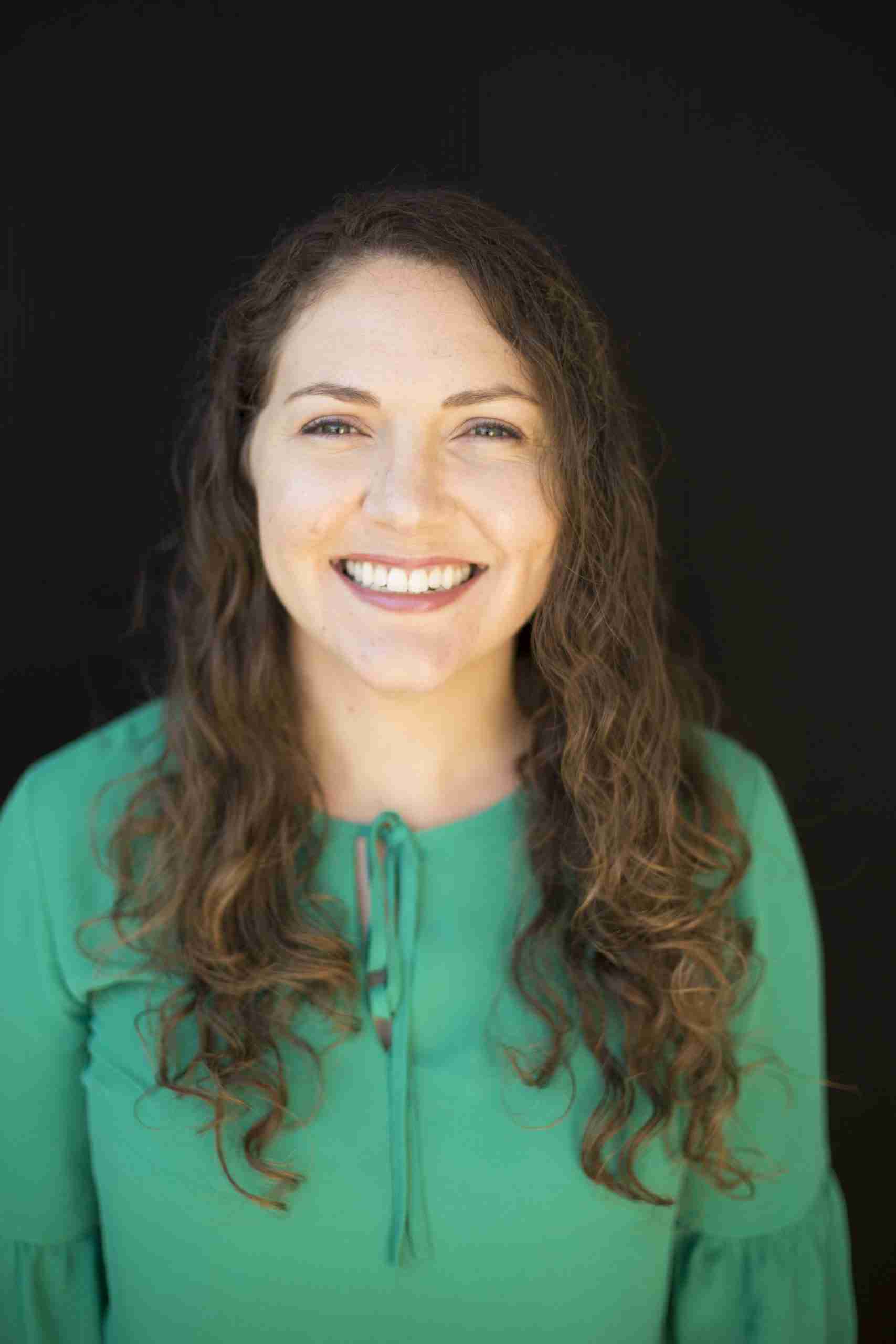
Meggie Connelly MS, RD, LDN is a Registered Dietitian Nutritionist, PCOS Advocate and Culinary Nutritionist who helps individuals with PCOS and chronic dieters go from confused, frustrated and exhausted to confident and balanced.