It’s Sunday afternoon. You’d planned to meal prep tonight. You had a grocery list, a recipe, maybe even a Pinterest board and color-coded containers.
You’re also exhausted.
Not regular tired. PCOS-tired. The kind where the thought of standing at the stove for an hour and a half makes you want to lie face-down on the kitchen floor.
If you’re nodding right now, I want you to hear me say this: scaling back your meal prep on a low-energy week is not failure. It’s strategy.
I’m a registered dietitian who specializes in PCOS — and I also live with PCOS myself. I know the meal prep fantasy: the Sunday afternoon in the kitchen, the rainbow of glass containers, the matching mason jars, the perfectly cubed sweet potatoes. And I know the reality: some weeks, you have it in you to make all of that happen, and some weeks, you don’t.
The trick — the thing that’s actually kept me, my clients, and my members consistent over the long run — is knowing how to scale back without falling off completely. (And not meal prepping on a Sunday).
I’m going to walk you through exactly what that looks like. One bowl. One formula. Zero guilt.
Why All-or-Nothing Meal Prep Doesn’t Work for PCOS
Here’s the thing about PCOS (or PMOS, as it’s now being called — Polyendocrine Metabolic Ovarian Syndrome, since the May 2026 Lancet consensus updated the name): chronic fatigue is one of the most under-acknowledged symptoms.
It’s the kind of fatigue that doesn’t get fixed by a good night’s sleep. The kind that shows up because of insulin resistance, blood sugar swings, inflammation, hormonal disruption, and — let’s be honest — the cumulative emotional weight of living in a body that often doesn’t feel like it cooperates with you.
Research consistently links insulin resistance — present in an estimated 44–70% of individuals with PMOS — to chronic fatigue through its effects on cellular energy metabolism and cortisol regulation. 2
And yet, the meal prep world acts like everyone has the same energy every Sunday afternoon.
So you set out to make four meals. You make one. You feel like you failed. By Wednesday, you’re picking at takeout and skipping vegetables, and by Friday you’re in the “screw it” loop, telling yourself you’ll just start over next week.
Meanwhile, you eat takeout for five days, your symptoms tick back up, and your trust in yourself takes another hit.
The fix isn’t trying harder. It’s prepping smarter when your energy is low.
Watch the Full Meal Prep Walk-Through
If you’d rather see this in action — the actual sautéing, the chopping, the very real moment of using up wilted kale — I walked through the entire meal prep on a recent live session for my PCOS Meal Prep Membership.
It’s a real-time peek at how I cook in my own kitchen, and the kind of teaching you get every week inside the PCOS Meal Prep Membership.
Prioritize ONE Meal (and Make Peace With the Rest)
When your energy is in the basement, the worst thing you can do is try to prep everything halfway. You’ll end up with a quarter-fridge of half-made things, no real lunches, and a vague sense that you wasted the night.
Instead, pick one meal — the one that, if you skipped it, would lead you to the worst food choices.
For most of us, that meal is lunch.
Here’s why: breakfast is easy to default-mode (Greek yogurt and fruit, a smoothie, eggs and toast — done). Snacks are mostly grab-and-go (cheese, fruit, hard-boiled eggs, hummus and crackers). Dinner is often when you have the most decision-making capacity, because work is over.
But lunch? Lunch is the gap. You’re between meetings, between clients, between school pickups. You don’t have time to cook, and if there’s nothing prepped, you’ll end up in the kitchen at 1pm trying to make a meal out of leftover hummus and one wilted scallion.
When I had my low-energy meal prep night last week, I had originally planned to make a snack, a smoothie batch, and lunch. I scaled back to just lunch. That was enough. The smoothie I can throw together in five minutes any morning. Snacks I can grab. But without a lunch ready, I would have been the one in front of the fridge at 1pm — and we both know what kind of food choices that leads to. The box of Cheezits in the pantry.
Pick your high-leverage meal. Default-mode the rest.
The Best Day to Meal Prep When You Have PCOS Fatigue
Somewhere along the way, the internet decided Sunday afternoon was the official meal prep day. Bright kitchen, sunlit countertops, a podcast playing, mason jars lined up in formation — you’ve seen the photos.
Sunday meal prep works great if Sunday is your high-energy day. For a lot of people with PMOS, it isn’t.
I personally meal prep on Monday nights. After client calls are done, I’m in the kitchen for an hour or so, and lunch is set for the rest of the week. Monday works for me because by Sunday evening I’m usually tired from the weekend, and I’d rather use that time to rest. By Monday night, I’ve eased back into the week and have a little more energy for the kitchen.
I also don’t always meal prep the same day I grocery shop. Sometimes I do, sometimes I don’t. When I shop on a Saturday or Sunday, I’m just putting the groceries away — the actual cooking happens later, when I’m ready for it.
For Monday night specifically, I always plan a really easy dinner — a sheet pan something, leftovers, a quick pasta, even takeout. I’m using my energy on meal prep, not on cooking two real meals in one night.
The other thing worth knowing: meal prep doesn’t have to happen all at once. You can chop vegetables on Sunday, cook the protein on Tuesday, batch a grain on Wednesday. Spreading it across the week — 20 minutes here, 30 minutes there — is a totally legitimate strategy, especially for low-energy weeks or busy seasons.
Play around with it. Your meal prep day is whatever day works for you.
The PCOS Bowl Formula: Cook Without a Recipe
The single biggest mindset shift that’s helped me — and my members — meal prep sustainably is treating recipes like formulas, not instructions.
A formula gives you a structure. You fill in the components with whatever you have, whatever’s about to go bad, whatever’s on sale, whatever sounds good. Same nutritional balance, infinite variations.
The bowl formula has five components:
1. A whole grain base. Rice, quinoa, farro, barley, wild rice, or that fun purple rice I keep ranting about. Whole grains are the move for PMOS because they’re higher in fiber and slower-digesting, which helps with blood sugar regulation. If you don’t have the energy to cook one from scratch, frozen pre-cooked pouches are a totally valid hack — I keep them on hand for exactly this reason.
2. A protein. Ground turkey, rotisserie chicken, canned salmon, tofu, beans, lentils — whatever you have. I like ground turkey because it flexes into Italian, Mexican, Asian, or just plain “savory” flavor profiles depending on what spices you reach for. I made a pound and a half last week, and the same base became lunch bowls, a quesadilla filling, and pasta sauce by Thursday. (This is the “cook once, eat twice” strategy in action.)
3. Cooked vegetables. Roast them on a sheet pan, sauté them in a skillet, throw frozen veggies on a tray with olive oil and salt — your method depends on your energy. Use what you have. That bag of half-forgotten zucchini and mushrooms in your produce drawer? Perfect. The kale that’s looking a little sad and wilty? Sauté it down with onions. It’s not going on a salad, but it’s perfect for a bowl.
4. A fresh element. Optional but lovely — chopped apple, pomegranate seeds, scallions, fresh herbs, a handful of grapes. It adds a textural contrast that makes the bowl feel like food, not like meal prep.
5. A dressing. This is the unsung hero of the entire system. A good dressing turns a pile of beige into something you actually want to eat. (I’m sharing my favorite below.)
The brilliant thing about the formula is that it scales with your energy.
Big energy week? Roast the squash, make the wild rice, batch up a sheet pan of Brussels sprouts, get creative.
Low energy week? Sauté one pan of whatever’s wilting in the produce drawer with some ground turkey and onions, cook a pot of rice, and call it a day.
Both versions are PMOS-friendly meals.
Use What You Have
Groceries are expensive right now, and food waste hits both your wallet and your stress level. Some of the most PMOS-aligned cooking I do is just using up what’s in my fridge.
A few rescue tactics I rely on:
Wilted greens? Don’t throw them out. They might not be salad-quality anymore, but they’re perfect for sautéing into a meat dish, blending into a smoothie, or wilting into a soup. The texture change you’re noticing doesn’t affect the nutritional value.
Peppers on their last leg? Cut off the soft spots, dice the rest, and toss them into your sauté. A slightly soft bell pepper is still full of vitamin C and color. Speaking of which — color variety matters more than you’d think for PCOS. Red, orange, purple, green, yellow — each color group offers a different mix of antioxidants and phytonutrients, and that variety is what helps support the inflammation side of PCOS.
Half-used proteins? Cook the whole package, season it generically (garlic, salt, pepper, maybe Italian seasoning), and let your meals decide where it goes. The same browned ground turkey can become tacos, pasta sauce, quesadilla filling, or a bowl topping depending on what you pair with it that night.
This is one of the things I love most about teaching culinary nutrition: it’s not about perfect recipes. It’s about having enough kitchen skill to walk into your kitchen, look at what you have, and feed yourself well.
The Dressing That Saves Everything
Here’s a formula that’s saved more of my low-energy weeks than I can count. Once you know it, you can stop buying expensive bottled dressings and start customizing flavors to whatever you’re cooking.
The Four-Part Dressing Formula
- Oil — about ½ cup, usually extra virgin olive oil
- Acid — about ¼ cup of vinegar (balsamic, apple cider, red wine, champagne) or citrus juice
- Emulsifier — 1 to 2 teaspoons of Dijon mustard (this is the magic — it helps the oil and acid stay mixed)
- Sweetener — 1 to 2 teaspoons of maple syrup or honey
- Plus: salt and pepper to taste, and any extras (garlic, herbs, citrus zest)
Shake or whisk together. Store in a jar in the fridge for up to two weeks.
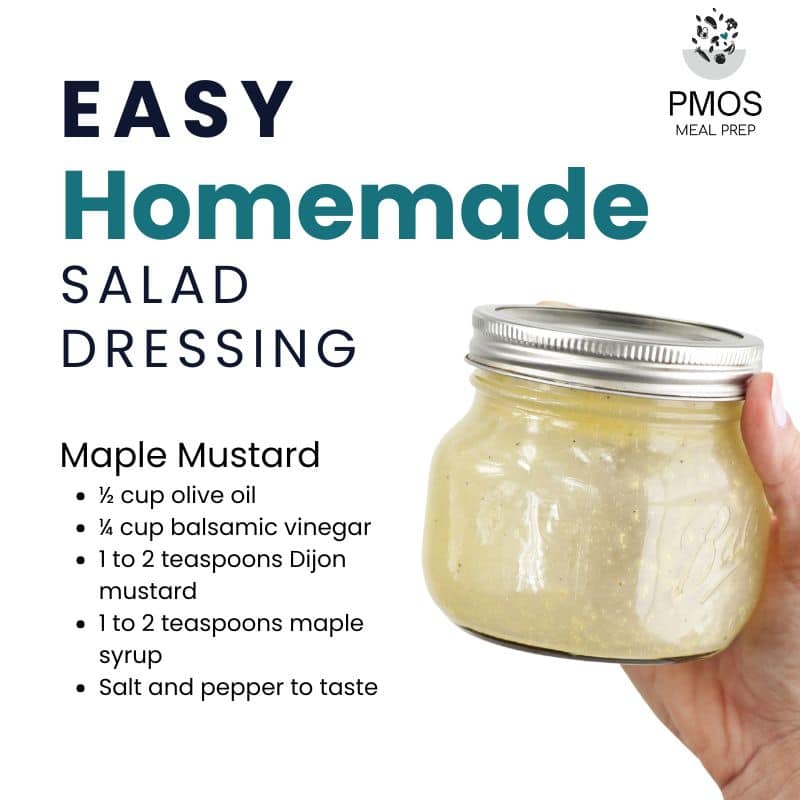
My Favorite Low-Energy Week Version: Maple Dijon Vinaigrette
- ½ cup olive oil
- ¼ cup balsamic vinegar
- 1 to 2 teaspoons Dijon mustard
- 1 to 2 teaspoons maple syrup
- Salt and pepper to taste
That’s it. It takes 90 seconds. It tastes like you tried.
Pour it on the bowl I described above. Use it as a marinade for chicken or turkey later in the week. Drizzle it on roasted vegetables — or even frozen vegetables on a sheet pan with olive oil and salt. One batch of dressing extends the flavor possibilities of every other thing in your kitchen for the next two weeks.
This is what culinary nutrition for PMOS actually looks like in practice: a few formulas you can rely on so cooking stops feeling like a constant decision-making tax.
Sustainable Beats Perfect
Here’s what I want you to take from this:
Some weeks you’ll do everything. Some weeks you’ll prep one bowl. Both count.
Both move you forward with PMOS — because the people who actually see lasting change aren’t the ones who execute the perfect prep week. They’re the ones who keep showing up, in whatever way they can, on whatever week they’re having.
The fatigue is real. The inconsistency is real. And so is the progress you make when you stop demanding perfection of yourself and start working with the energy you actually have.
Want a Place to Start?
If you’re new to PCOS nutrition and want a structured starting point, my Free PCOS Nutrition Course walks you through the foundations of eating in a way that supports your hormones — without restriction, without 30-day overhauls, and without “diet rules” you can’t sustain.
[ Get the Free PCOS Nutrition Course → ]
And if you want to cook with me live every week, get weekly meal plans/guides, and learn the kind of formulas and skills I just shared, that’s exactly what happens inside the PCOS Meal Prep Membership.
I’d love to have you in either.
— Meggie
Pin for later!
Citations

Meggie Connelly MS, RD, LDN is a Registered Dietitian Nutritionist, PCOS Advocate and Culinary Nutritionist who helps individuals with PCOS and chronic dieters go from confused, frustrated and exhausted to confident and balanced.